 ™
TopicByteDance, Alibaba and Tencent order $35 billion in Nvidia chips
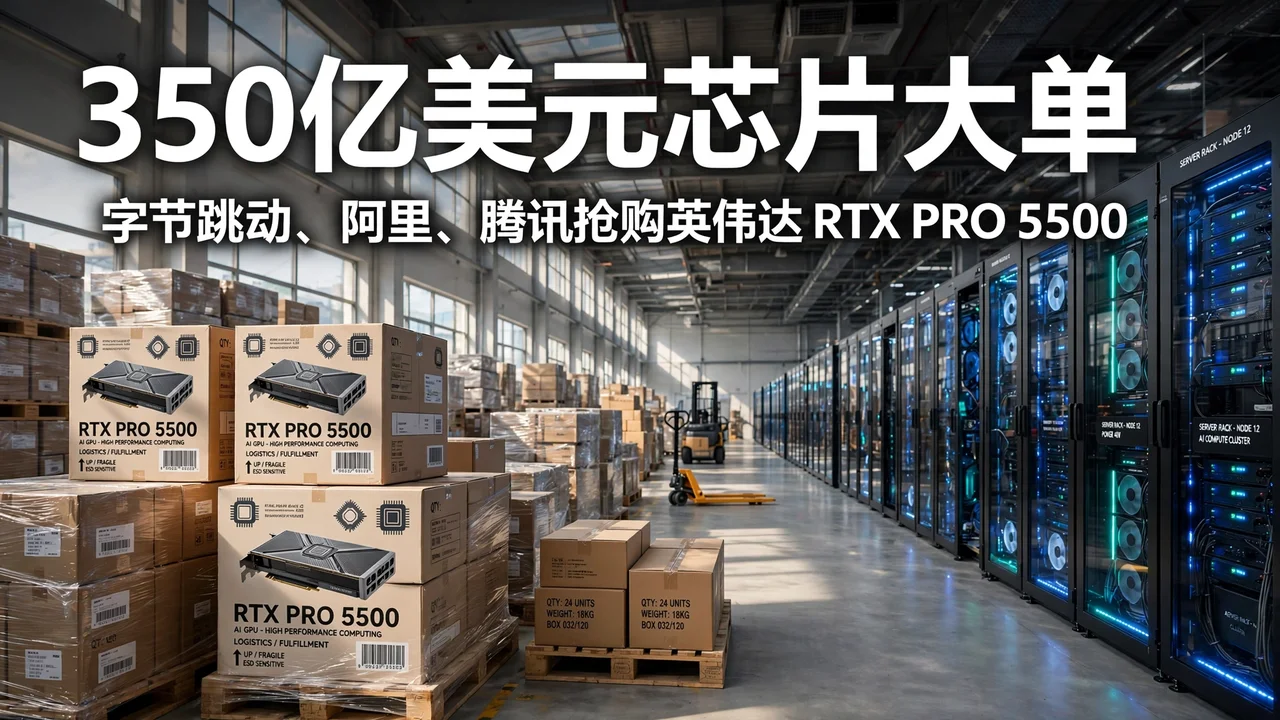
ByteDance, Alibaba and Tencent Place Over $35 Billion in Nvidia Chip Orders, Buying Up China-Compliant RTX PRO 5500
Reuters reported exclusively on October 20, citing two people familiar with the matter, that ByteDance, Alibaba and Tencent have ordered more than 3 million of Nvidia's new RTX PRO 5500 cards for over $35 billion — the first quantified disclosure of Chinese tech firms' demand for Nvidia hardware under US export controls. Two sources said Nvidia has told customers and partners it cannot guarantee full delivery.
Latest
2 updates · newest first-
Factual update: Chinese media identify the buyer as Tianyang Technology (300872.SZ), rendered by Reuters as Tansun Technology.
-
Story expansion: expanded from the Oct 21 morning-batch flash with the Reuters exclusive's Nvidia response, Jensen Huang's remarks, the RTX 6000D predecessor line and the export-control timeline.
Further updates will appear here
What happened
The orders had not been previously reported. Two people familiar with the matter told Reuters the three companies' orders work out to about $11,400 per card, worth more than $35 billion combined; other sources said total orders for the RTX PRO 5500 from customers in China have exceeded 6 million cards. The sources requested anonymity as they were not authorized to speak to the media.
Two other sources and a third person familiar with the matter said Nvidia has told customers and partners it cannot guarantee filling all orders because demand from Chinese technology companies far exceeds planned production. Three sources said the Chinese companies primarily want the cards for AI inference — running trained models to generate responses — which requires less computing power than training models on massive datasets.
Nvidia CEO Jensen Huang has said the restrictions reduced Nvidia's share of China's AI data-centre chip market from a near monopoly to effectively nothing. ByteDance, Alibaba, Tencent, the US Commerce Department's Bureau of Industry and Security and China's Ministry of Industry and Information Technology did not respond to Reuters' requests for comment; TSMC declined to comment.
Chinese producers of workstation chips and cards have experienced "unprecedented growth since 2022," when the curbs were first imposed. US firms continue to be restricted by a combination of outdated US export controls, which cover gaming products released nearly a half a decade ago, and China's own limit on US imports.
— Nvidia spokesperson (quoted by Reuters)
Key facts
- Order scale: The three companies ordered more than 3 million cards at about $11,400 each, worth over $35 billion; two sources said total orders from customers in China have exceeded 6 million cards, not previously reported.
- Supply gap: One source said Nvidia told partners they might receive only 5%–10% of requested quantities; another said the company could produce no more than 3 million RTX PRO 5500 cards globally in 2027.
- Delivery timeline: Nvidia told customers to expect early samples in December, with commercial deliveries beginning in the first quarter of 2027; from 2027 much of its TSMC capacity will go to the next-generation Rubin platform rather than products like the RTX PRO 5500.
- Product positioning: The RTX PRO 5500 is built on the Blackwell architecture with 84GB of GDDR7 ECC memory, designed for rack-mounted workstation deployment; Nvidia lists physical and agentic AI, generative AI and LLM inference among its target workloads. It is among the most powerful Nvidia chips still available to Chinese buyers, and product specifications seen by Reuters show performance similar to the RTX 6000D.
- Previous generation: Last year's compliant RTX 6000D has been discontinued and its market price in China has doubled; Reuters reported last year that major firms initially showed little interest, with some declining to place orders, as buyers viewed the chips as overly expensive given their capabilities and hoped Washington would eventually allow sales of more powerful processors.
- Follow-on buying: Shenzhen-listed fintech and AI-computing services company Tianyang Technology (300872.SZ; rendered by Reuters as Tansun Technology) said in an October 13 filing it had agreed to buy 20,000 RTX PRO 5500 cards from an unidentified counterparty, cautioning that supply shortages and overseas technology controls could delay deliveries or reduce volumes.
Background
US export controls on AI chips to China began in 2022. Under current rules, Nvidia's Blackwell-based B300 data-centre chip may not be sold to China, while exports of its Hopper-based H200 are reviewed case by case with licensing conditions. The RTX PRO 5500 sits in the less-powerful-but-export-compliant tier, making it one of the most powerful Nvidia chips Chinese buyers can still purchase.
The curbs have also pushed Chinese firms toward domestic suppliers. Reuters wrote that Huawei, in particular, has gained market share, though Chinese chipmakers have generally struggled to match leading American products, partly because access to the foreign equipment used to make the most advanced semiconductors is restricted.
In the middle of last year Nvidia launched the reduced-capability, compliant RTX 6000D. Reuters reported at the time that major firms initially showed little interest, with some declining to place orders, as buyers viewed the chips as overly expensive given their capabilities and hoped Washington would eventually allow sales of more powerful processors. With curbs sustained and computing capacity scarce, two sources said the RTX PRO 5500 has now become a more attractive substitute.
The demand shift also shows in intended use: three sources said the Chinese companies primarily want the cards for AI inference. Inference means running trained models to generate responses and requires less computing power than training; Nvidia's official materials likewise list "generative AI and LLM inference" among the RTX PRO 5500's target workloads.
Why it matters
This is the first quantified disclosure of China's demand for Nvidia hardware under export controls: $35 billion in orders against 5%–10% deliverability and at most 3 million cards of global 2027 capacity — the compute gap now has a concrete number.
CompaniesNVIDIA·Alibaba·ByteDance·Tencent
Comments
Related
- Oct 21ByteDance, Alibaba, Tencent Place Over $35 Billion in Nvidia Chip Orders
- Oct 9Super Micro Contractor Pleads Guilty in $2.5B AI-Chip Smuggling Case
- Oct 2DOJ Arrests California Tech Firm Owner Over Alleged $300M AI Server Smuggling to China
- Oct 6Mistral Debuts “Le Chonk”: Open-Weight Large 4 in Public Preview, Weights Drop Oct 27
- Oct 20Dream Labs Exits Stealth: Launches Dream-1 Robot Control Model, Closes $90M Seed Round
Today
Oct 21 Wednesday- Brief
- GitHubGitHub Weekly Vol.2: 6 Projects Worth Your Time
Tested or read — weeklyAll →
- Quiz
- Call
Latest news
All →- Oct 21GitHub Launches Package Firewall in Public Preview
- Oct 21Anthropic: Claude Designed 17 Protein Binders Against Scorpion Neurotoxins
- Oct 21OpenAI Acquires Biopharma Software Company Orchestra Bio
- Oct 21SpaceX and Tesla Form Merger Review Committees in Potential Record-Breaking Tie-Up
- Oct 21Anthropic Posts $80.7B Half-Year Net Loss in Draft IPO Prospectus; Compute Tab Tops $600B
- Oct 21VideoGen Unveils Model 1, Its First AI Video Generation Model: Up to 10-Minute Films From a Single Prompt