 ™
™Microsoft Ships Its Own Voice Stack: 60-Language Streaming Transcription + Seconds-Level Voice Cloning
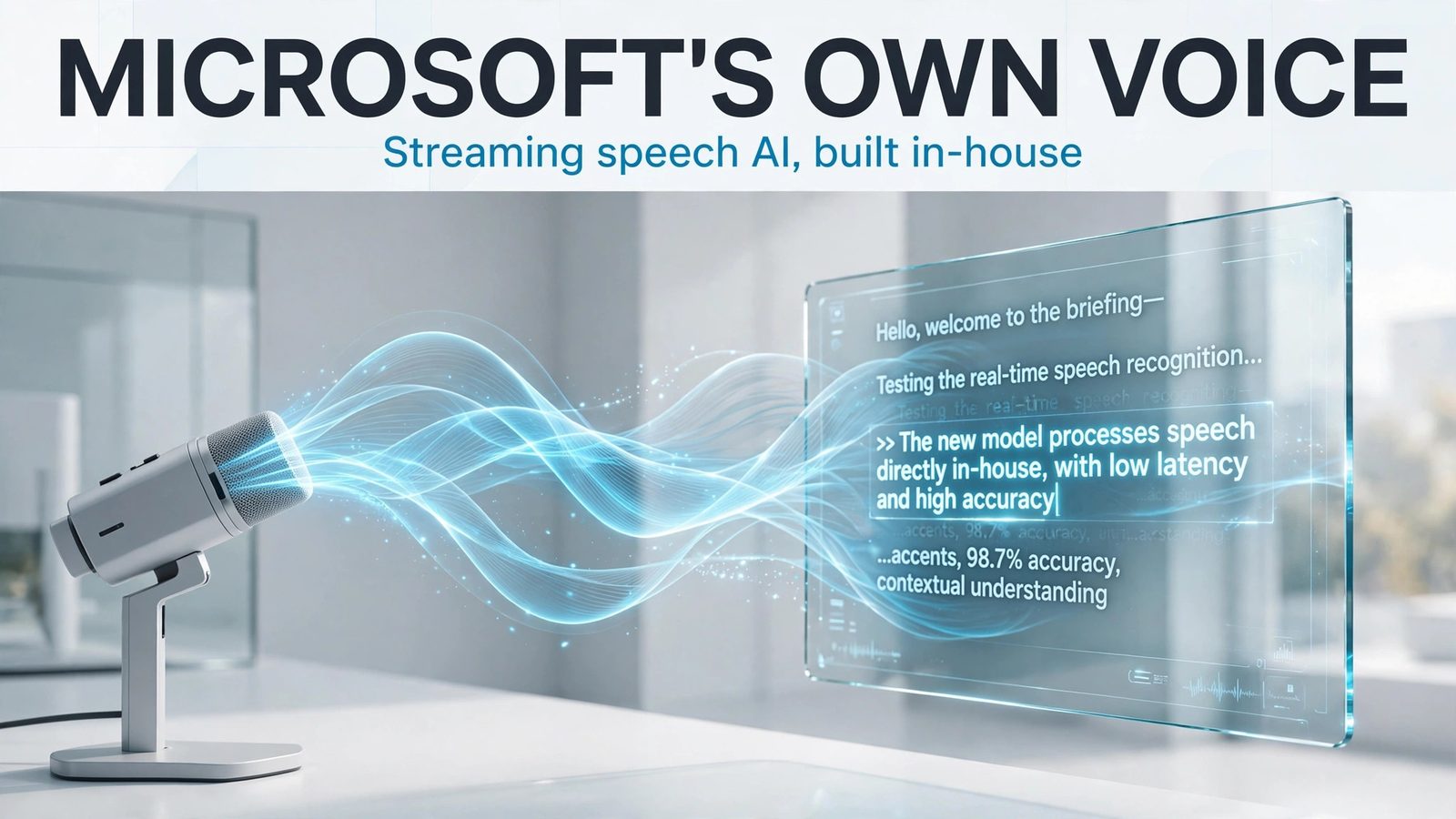
On October 1, the Microsoft AI official blog launched a homegrown voice model stack: streaming transcription model MAI-Transcribe-2-Streaming supports 60 languages with first-word latency of about 100 milliseconds, which Microsoft claims ranks #1 on Artificial Analysis accuracy benchmarks; the simultaneously released MAI-Voice-2.1 and Flash text-to-speech models clone a voice from just seconds of reference audio.
What Happened
On October 1, Microsoft AI unveiled three homegrown voice models on its official blog microsoft.ai: streaming transcription model MAI-Transcribe-2-Streaming, plus two text-to-speech models, MAI-Voice-2.1 and MAI-Voice-Flash, covering both speech recognition and speech synthesis.
The transcription model is all about real time: 60 languages, continuous automatic language detection, ~100ms first-word latency, priced at $0.54 per audio hour (promotional price this year). Microsoft claims it ranks #1 on Artificial Analysis for both final and partial transcription accuracy. On the TTS side, MAI-Voice-2.1 covers 23 languages and 26 regions, with same-speaker cross-language support that keeps local accents ($22 per million characters); the Flash edition pushes latency down to 150ms ($15 per million characters). Voice cloning needs only seconds of reference audio, but requires approval and ships with consent safeguards.
Key Facts
- When & where: October 1, 2026, first published on the Microsoft AI official blog (microsoft.ai); covered consistently by The Decoder, RuntimeWire, TestingCatalog, and WindowsReport.
- Transcription: MAI-Transcribe-2-Streaming: 60 languages, continuous automatic language detection, ~100ms first word; Microsoft claims #1 on Artificial Analysis final/partial transcription accuracy; $0.54/audio hour (promotional price this year).
- Speech synthesis: MAI-Voice-2.1: 23 languages / 26 regions, same-speaker cross-language with local accents, $22 per million characters; Flash edition: 150ms latency, $15 per million characters.
- Voice cloning: Clones a voice from seconds of reference audio; requires approval and includes consent safeguards.
Context
OpenAI had already launched its Realtime API and TTS models. Microsoft's three new models are all built in-house, with no outside models.
Why it matters
All three transcription and speech models are built in-house by Microsoft; transcription has ~100ms first-word latency at $0.54 per audio hour, and the Flash TTS model runs at 150ms latency for $15 per million characters.
CompaniesMicrosoft
Comments
Related
- Oct 17Microsoft's MAI-Base-2 Completes Pre-Training: 2T-Parameter All-MoE Architecture, Trained 38 Days on 16,000 GB200s
- Oct 12Microsoft Unveils Maia 300, Its Third Custom AI Chip, With Deployments Possibly Topping One Million Next Year
- Oct 8Google Launches Universal Work Agent Gemini Agent, Running Gemini and Anthropic's Claude
- Oct 13Drex 1.5 vs Decision-1: The Models That Score, Not Write
- Oct 10Microsoft Launches Decision-1, a Decision Model That Outputs Calibrated Probabilities, Not Text
Today
Oct 19 Monday- Brief
- GitHubGitHub Weekly Vol.1: 8 Projects Worth Your Time
Tested or read — weeklyAll →
- Quiz
- Call
Latest news
All →- Oct 18Anthropic to Commit 5% of Shares to New Public Benefit Fund
- Oct 19Stably AI's Orca Tops GitHub Daily Trending: One Desktop App to Orchestrate 30+ Coding Agents
- Oct 19Jailbroken PS5 Becomes a Local AI Server: Qwen3.8-27B Hits ~20 tok/s, Small Models Top 100
- Oct 19Anthropic Internal Study: Junior Share of Technical Staff Falls to 14%, Meeting Time Up 20%
- Oct 18Claude Cracks 25-Year Cryptography Mystery in Half an Hour: NIST Curve Seeds Came From a 1997 Clock
- Oct 18OpenCode Hit by "Distillation Attack": API Keys of About 1.4% of Users Compromised